
Whether you are sitting on a pile of idle assets looking to get the best value out of them, or you are a buyer constantly searching for the right material at the right price — the way an auction is structured affects you directly. Lot bidding and single lot selling are the two primary formats used across online auction platforms in India today, and understanding the difference between them is genuinely useful whether you are on the selling side or the buying side of the transaction.
Most people only think about auction formats from one angle. Sellers focus on which format gets more money. Buyers focus on which format gives them better access. The truth is that both questions are connected — and the format of decision shapes the entire experience for everyone involved. Whether you participate through auction bidding sites or directly on a live auction platform, the format you encounter will define your experience from start to finish.
What Is Lot Bidding and How It Works for Both Sides?
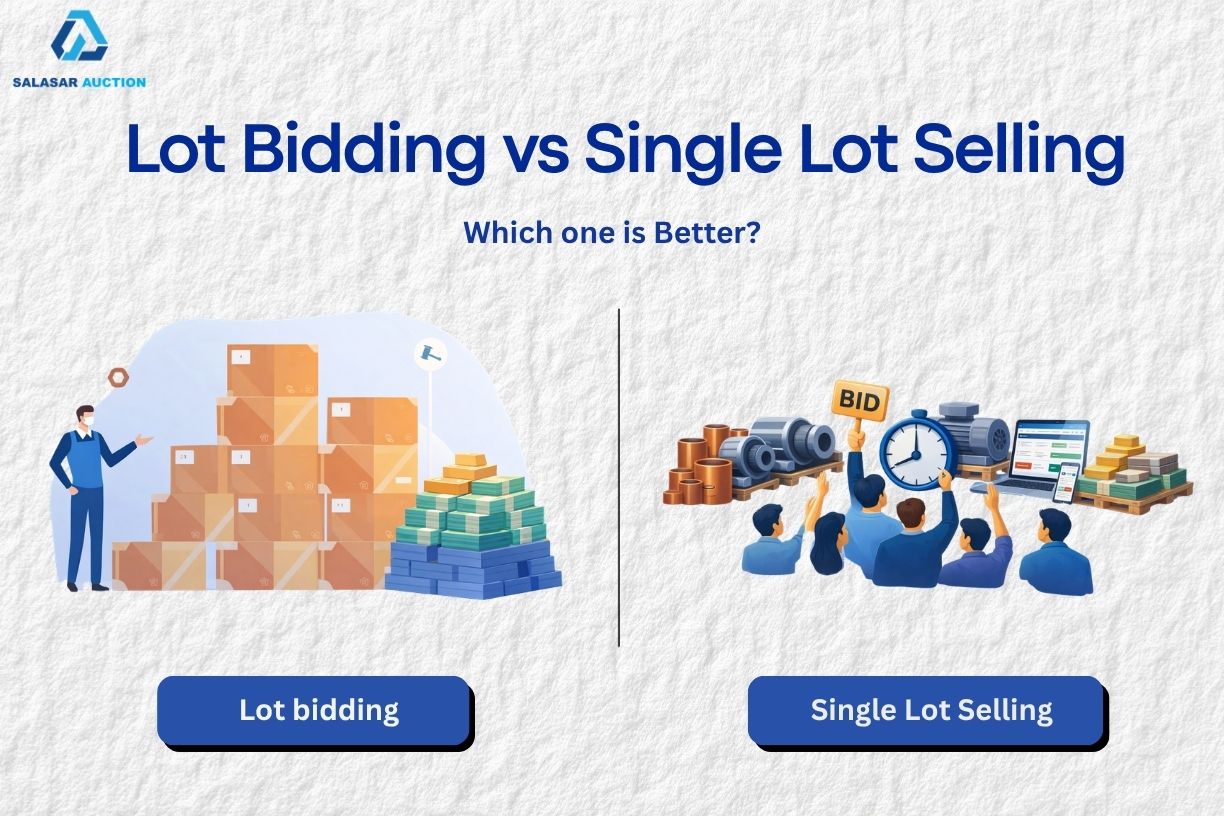
Lot bidding means the seller divides the total available material or assets into smaller, separate portions. Each lot is listed independently on the scrap auction online platform with its own listing, its own bidders, and its own final price.
From a seller's perspective, more buyers can participate because not everyone needs to commit to the full quantity. More participation leads to more competition, and more competition almost always means stronger price realization. A seller with a large or varied stock of surplus assets or used machinery will typically find that breaking it into well-sized lots brings in a wider and more active pool of bidders on any digital auction platform.
From a buyer's perspective, lot bidding gives the flexibility to bid only on what is actually needed. Nobody is forced to take everything just to get access to the portion they want. If storage is limited, the requirement is specific, or the budget is defined, lot bidding on online scrap auction sites in India allows full participation on the buyer's own terms. This is one reason why lot-based formats have become increasingly popular across scrap auction sites in India and industrial scrap auction platforms alike.
What Is Single Lot Selling and When It Makes Sense?
Single lot selling means the entire quantity or asset is offered as one package on a live auction site. The highest bidder takes everything. No splitting, no separate listings, one winner.
For sellers, the appeal is pure simplicity. One transaction, one buyer, one payment, one pickup. When a facility needs to be cleared quickly or there is simply no bandwidth to manage multiple lot winners, a single lot format on a live auctions online platform gets the job done cleanly. It also tends to attract serious, high-capacity buyers who are willing to pay well for the convenience of a complete transaction.
For buyers, single lot auctions are a good fit when the capacity and appetite exist to absorb the full quantity. If a business regularly processes large volumes of scrap or surplus material, single lot listings on bidding sites allow everything to be secured in one go — without competing across multiple separate auctions. For those who regularly buy industrial scrap in bulk, this format often delivers the most straightforward buying experience.
Why Lot Bidding Tends to Attract More Participants?
Here is something many first-time sellers on an online bidding platform do not immediately realise. The number of buyers who can participate in a smaller lot is always significantly higher than the number who can take the entire quantity at once.
Not every buyer operates at a scale where large volumes of scrap or used machinery can be absorbed in a single purchase. When material is divided into manageable lots on scrap auction websites, it becomes accessible to a much larger and more diverse group — small traders, mid-size processors, and large organizations all competing side by side. That competition is precisely what drives prices up.
From a buyer's perspective, this wider participation creates a healthier and more transparent market. Prices reflect genuine demand rather than a one-sided negotiation. On any active e auction platform in India, lot-based auctions tend to produce fairer and more competitive outcomes for everyone involved. This holds true whether participation happens through online scrap bidding on a dedicated platform or through live bidding on a broader auction site.
Where Single Lot Selling Holds Its Ground?
It would be unfair to suggest lot bidding is always the stronger choice. There are genuine situations where single lot selling makes more practical and financial sense — for both sides of the transaction.
For sellers, speed is the most obvious advantage. Listing to one lot requires far less preparation than carefully dividing and describing multiple lots. There is also a specific category of buyer on scrap e auction sites who strongly prefer single lot transactions — buyers who do not want to manage multiple pickups or participate in several separate auctions. These buyers often pay a premium for certainty, which means strong results are still achievable with a simpler listing structure.
For buyers, single lot formats reduce complexity. One auction, one decision, one purchase. When a procurement process benefits from a single clean transaction rather than tracking multiple lot outcomes, the single lot format suits the workflow well. Many buyers who regularly source through scrap metal online auctions prefer this format precisely because it removes the need to monitor and manage multiple bids at the same time.
Lot Bidding vs Single Lot Selling: A Quick Comparison
|
Criteria |
Lot Bidding |
Single Lot Selling |
|
How material is sold |
Entire material sold to one single buyer |
Material divided into lots — each lot sold to different buyers |
|
Buyer participation |
only bulk buyers who can take everything |
small & large buyers, everyone can participate |
|
Price realization |
Good only if a strong bulk buyer is present |
more competition = higher overall price |
|
Speed & simplicity |
Faster — one winner, one deal, done |
Takes more time — multiple lots to manage |
|
Best suited for |
Urgent disposal, uniform bulk material |
Diverse scrap, surplus & varied assets |
The Platform You Use Matters as Much as the Format
Whether on the selling side or the buying side, the platform plays a critical role in shaping the final outcome.
A well-run e auction platform in India does more than hosts a listing. For sellers, it brings in a verified and active buyer base and creates the competitive environment that drives better prices. For buyers, it provides reliable listing information, fair bidding mechanics, and the confidence that the process is structured and trustworthy.
On sell scrap online India platforms with strong buyer activity, even a single lot auction can attract serious competition. On a platform with limited reach, even a well-structured lot auction may underperform. This is why evaluating the platform alongside the format is important — the right format on the wrong platform will not deliver the right result for either side.
It is also worth understanding that online reverse auction formats work differently from standard forward auctions. On reverse auction websites in India, buyers drive the price discovery process rather than sellers. Knowing which type of online auction you are participating in — whether a forward lot auction or an online reverse auction — is equally important before engaging on any platform.
How to Think About Format Before You Participate?
For sellers, the most useful exercise before listing is to think about the auction from the buyer's perspective. Who is likely to bid? What quantity can they realistically absorb? What format makes it easiest for them to participate and compete? When these questions are answered honestly, the right format usually becomes clear. Varied material with a broad buyer base almost always benefits from lot bidding on auction platform scrap listings. Uniform material with a defined bulk buyer market may be better served by single lot selling.
For buyers, the preparation looks different. In a lot bidding auction, it is possible to target exactly what is needed without overcommitting. In a single lot auction, full preparation is essential before the first bid — logistics, storage, and budget must all align with the complete quantity. Buyers who enter live auctions online without this clarity often either underbid out of caution or overbid out of enthusiasm. Neither outcome serves them well.
Whether browsing e auction sites in India or participating in live bidding on a dedicated scrap platform, a few minutes spent understanding the format before bidding consistently leads to better decisions and better results.
Conclusion
Lot bidding and single lot selling are both legitimate and effective formats — when used in the right situation, for the right material, on the right platform. The growth of auction platform in India options across every category means that both sellers and buyers today have more tools and more choices available than ever before.
For sellers, understanding the format is one of the simplest ways to improve auction outcomes without changing anything else about the material or the listing. For buyers, it is one of the most overlooked advantages in any bidding situation.
A well-chosen format, on the right digital auction platform, with the right participants — that combination is often the difference between an average outcome and a genuinely strong one. For both sides of the transaction.
By Salasar Auction– Your trusted partner in India’s digital auction revolution.